
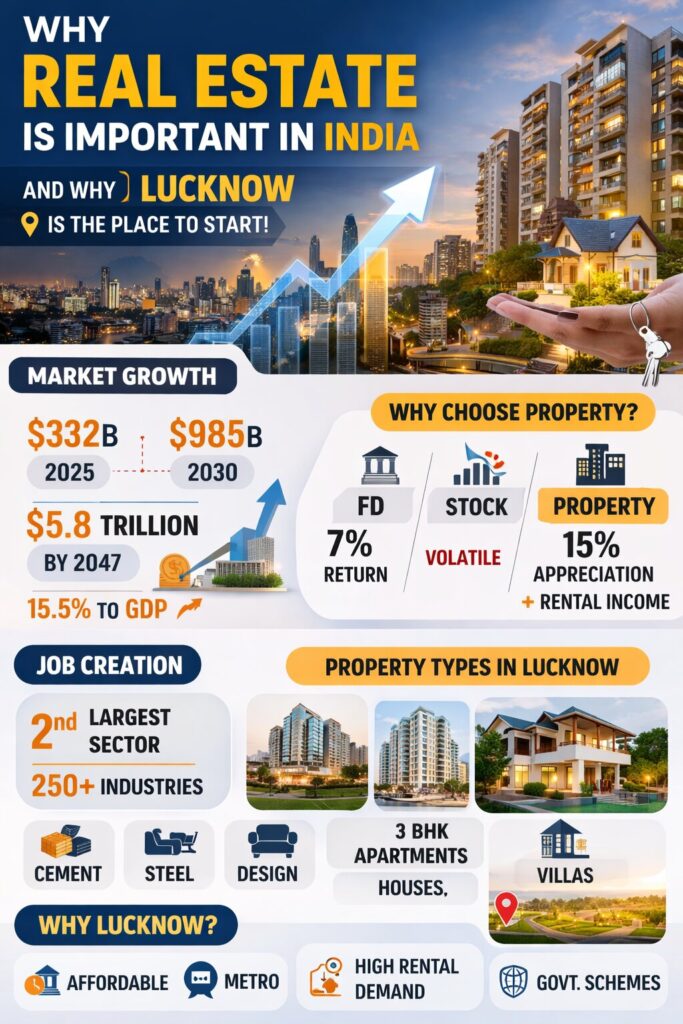
The Real Estate is important in India because If you had ₹50 lakhs in your bank account today, where would you put it — a fixed deposit earning 7% annually, the stock market riding waves of uncertainty, or a 2 BHK in Lucknow that appreciates 15% every year while generating monthly rental income?
For most Indians, the answer isn’t even close. Real estate has always been more than just an investment — it’s security, status, legacy, and livelihood all wrapped into one. But beyond personal wealth, real estate plays a role so massive in India’s economy that most people don’t even realise it.
Let’s unpack exactly why real estate is India’s most powerful economic engine — and why cities like Lucknow, with their booming demand for flats, plots, villas, and houses, sit at the very heart of this story.
The Numbers That Tell the Story
Real estate isn’t just big in India — it’s enormous.
India’s real estate market is set for significant expansion, projected to grow from $332.85 billion in 2025 to $985.80 billion by 2030 — a staggering CAGR of 24.25%.
The sector is expected to expand to US$5.8 trillion by 2047, contributing 15.5% to the GDP from an existing share of 7.3%.
The real estate industry in India is the second-largest employment generator after agriculture. Only farming creates more jobs. Let that sink in.
In Lucknow specifically? Housing sales value jumped 48% in Q1 2025 alone — the highest among all tier-2 cities in India. Demand for everything from 2 BHK flats in Lucknow to luxury villas in Lucknow is surging at a pace that’s turning heads across the country.
6 Reasons Real Estate is Critical to India’s Growth
1. It Drives the Entire Economy — Not Just One Sector
When someone buys a 3 BHK in Lucknow, they’re not just buying four walls and a ceiling. They’re triggering a chain reaction across 250+ industries.
Think about it:
- Cement, steel, bricks → manufacturing sector grows
- Plumbers, electricians, painters → skilled trades flourish
- Interior designers, furniture makers → retail and services boom
- Banks and NBFCs → home loans fuel financial sector growth
- Transport and logistics → materials need to move
Key sectors like IT, financial services, and e-commerce remain major employment drivers, indirectly supporting real estate growth in metropolitan regions. The reverse is equally true — real estate growth fuels those sectors right back.
Every new housing colony built in Lucknow — whether it’s a cluster of 2 floor houses, a gated community of villas, or a high-rise of flats — creates economic ripples felt far beyond the city limits.
2. It’s India’s Most Accessible Wealth Creator
Stocks can crash overnight. Gold fluctuates. FDs barely beat inflation. But land and property in India has historically delivered consistent, tangible, multi-generational wealth.
Consider this journey:
- A family buys a plot in Lucknow on Faizabad Road in 2018 for ₹20 lakhs
- By 2025, the same plot is worth ₹65 lakhs — a 225% return in 7 years
- They build a 2 floor house in Lucknow and rent the ground floor for ₹15,000/month
- That’s ₹1.8 lakhs in annual rental income plus capital appreciation
This is the power of real estate as a wealth tool — it works on multiple levels simultaneously. And unlike stocks, you can live in it, rent it, or pass it to your children.
The Anarock H1 2025 survey shows 36% of buyers now prefer properties priced between ₹90 lakh– 1.5 crore, up from 18% before Covid-19 — proof that aspiration and wealth creation are both driving Indian buyers upward.
3. It Solves India’s Massive Housing Shortage
India has a housing problem — and it’s bigger than most realise.
About three houses are built per 1,000 people per year compared with the required construction rate of five houses per 1,000 population. The current shortage of housing in urban areas is estimated to be ~10 million units.
That’s 10 million families without adequate homes — today.
Knowing that there is a shortage of 10 million units in urban areas and 25 million units of affordable housing will be required by 2030, the urgency has never been higher.
This is where Lucknow is playing a critical role. As a Tier-2 city with strong infrastructure, metro connectivity, and government support, Lucknow is absorbing massive demand from:
- Families migrating from smaller UP towns
- Professionals moving for IT and government jobs
- NRIs returning to their roots
The range of property options — from affordable 2 BHK flats in Lucknow to spacious 4 BHK in Lucknow, from compact plots in emerging areas to sprawling villas in Lucknow’s gated communities — makes the city uniquely positioned to address this housing gap.
4. It’s a Government Priority — And That Means Momentum
Governments don’t invest where there’s no future. The fact that the Indian government has poured resources into real estate through multiple schemes signals exactly how vital it considers the sector.
Major Government Initiatives Powering Real Estate:
Pradhan Mantri Awas Yojana (PMAY)
- “Housing for All” mission
- Subsidised home loans for EWS, LIG, MIG buyers
- Directly boosted demand for affordable flats and houses across India
RERA (Real Estate Regulation Act)
- Protects buyers, regulates builders
- Increased buyer confidence = increased transactions
- UP RERA https://www.up-rera.in/index registered 308 projects worth ₹68,328 crores in 2025 alone
Smart Cities Mission
- Lucknow is a Smart City beneficiary
- Upgraded infrastructure directly increases property values
- Better roads, metro, digital governance = higher demand for properties
LDA Schemes in Lucknow
- Government-backed plots and flats at 20-40% below market rates
- Anant Nagar offering 10,000 flats + 2,100 plots
- Creates accessible entry points for first-time buyers
Reforms such as the Real Estate (Regulation and Development) Act, Goods and Services Tax, and Prohibition of Benami Property Transactions Act have collectively enhanced accountability and consumer protection.
When policy and private investment align, markets accelerate. That’s exactly what’s happening in Lucknow right now.
5. It Creates Employment at Every Level of Society
Real estate doesn’t just create jobs for engineers and architects. It creates livelihoods for:
- Daily wage labourers on construction sites
- Masons and carpenters building homes
- Real estate agents facilitating deals
- Property lawyers handling documentation
- Interior decorators finishing spaces
- Security guards and maintenance staff running housing societies
- Shopkeepers and vendors in new colonies
When a new residential project — say a 200-unit apartment complex offering 3 BHK in Lucknow — comes up in Gomti Nagar Extension, it doesn’t just house 200 families. It employs hundreds of workers during construction and dozens more post-completion. It creates demand for a new grocery store, a school, a clinic, a salon.
The real estate industry in India is the second-largest employment generator after agriculture and contributes around 7% to the GDP. By 2030, it is projected to contribute 13% to the GDP and reach a market size of $1 trillion.
Every house built is an economic engine unto itself.
6. It Anchors Financial Security for Indian Families
Ask any Indian family what their single most important financial asset is. Nine times out of ten, the answer is their home.
In a country where:
- Social security is limited
- Healthcare costs are rising
- Retirement planning is still nascent
Property is the safety net.
A family that owns a house in Lucknow — whether it’s a modest 2 BHK flat, an independent house in Indira Nagar, or a 4 BHK in a premium Gomti Nagar project — holds an asset that:
- Provides shelter (eliminating rent burden)
- Appreciates steadily over time
- Can be mortgaged during financial emergencies
- Generates passive rental income when not self-occupied
- Passes on as inheritance to the next generation
This is why Indians — especially the middle class — remain obsessed with property ownership. It’s not just emotional. It’s rational.
Why Lucknow Specifically Makes Sense Right Now
India has 640+ districts. So why are buyers and investors zeroing in on Lucknow?
Because Lucknow checks every box that makes real estate valuable:
✅ Growing economy — IT, defence corridor, logistics, education
✅ Infrastructure boom — metro expansion, expressways, smart city
✅ Affordable pricing — 60-70% cheaper than metros with better returns
✅ Policy support — RERA compliance, LDA schemes, PMAY benefits
✅ Diverse inventory — plots in Lucknow, houses in Lucknow, flats in Lucknow, villas in Lucknow across all budgets
✅ Strong rental market — universities, hospitals, corporates creating steady tenant demand
Whether you’re eyeing a 2 BHK in Lucknow for ₹35 lakhs on Faizabad Road, a 3 BHK in
Lucknow for ₹85 lakhs in Gomti Nagar Extension, a 4 BHK in Lucknow luxury apartment in
Sushant Golf City, an independent 2 floor house in Lucknow in Indira Nagar, a villa in Lucknow for premium lifestyle living, or raw plots in Lucknow for maximum long-term appreciation — the city has something for every budget and every goal.
Conclusion
Real estate is important in India because India itself is important — a rising economic superpower with 1.4 billion people, a growing middle class, rapid urbanisation, and an insatiable hunger for better living.
India’s real estate drew ₹37,625 crore ($4.3 billion) in institutional investment in 2025, led by a 52% rise in domestic capital. When global funds put billions into Indian real estate, they’re betting on the same thing every Indian homebuyer instinctively knows: property in India only goes one way over time — up.
And in that rising tide, Lucknow — with its affordable flats, spacious houses, premium villas, and high-potential plots — is one of the best boats to be in.
The Complete Guide to Property Types in Lucknow: Flats, Villas, Houses & Plots
The question isn’t whether real estate matters in India. The real question is: Are you in yet? Disclaimer: Property prices and market data are based on 2025 research. Real estate investment involves market risks. Always consult with local real estate experts and financial advisors before making investment decisions